Halter

275%
Of monthly U.S. MQL target
$1B
Series D valuation, now $2B
-61%
Cost per SQL
Driving adoption of the world’s most advanced virtual cattle fencing in the U.S. and New Zealand, enabling more efficient, profitable, and sustainable farming.
The Challenge
How do you get a farmer to trust a startup with their herd, when their family has farmed the same way for generations?
“Mate, I’ve been doing this forever, why should I change what I’m doing?”
That was a key hurdle for Halter, the company behind solar-powered smart collars that let farmers fence, move and monitor cattle from their phone. Through Double, I led Halter's paid creative strategy and execution across New Zealand and the U.S., in the run-up to their Series D.
New Zealand has fewer than 11,000 dairy farmers, with an average age of 50. Halter meant spending tens to hundreds of thousands of dollars on seemingly complex, unnecessary technology from a young startup. In the U.S., few ranchers had ever heard of Halter, yet the size of their ranches meant they needed the tech even more than their peers ‘down under’.
Three things stood in the way:
Understanding the value. Farmers couldn't see how a collar would save them time or make them money.
Trust. They assumed a tech startup didn't understand how a farm runs or how to care for their land and animals.
Scale. Paid creative had to bring in qualified leads reliably, month after month, in two very different markets.

My Role
Storytelling: reshaped how Halter sold themselves
Repositioned Halter's ad messaging from one feature (virtual fencing) to the outcomes farmers actually buy: hours back, more grass, more milk, more profit.
Turned farmer research into a full-funnel story: time savings to win attention, hard ROI to convert.
Worked directly with Halter's product, sales and marketing teams to turn complex product detail into a story farmers understood.
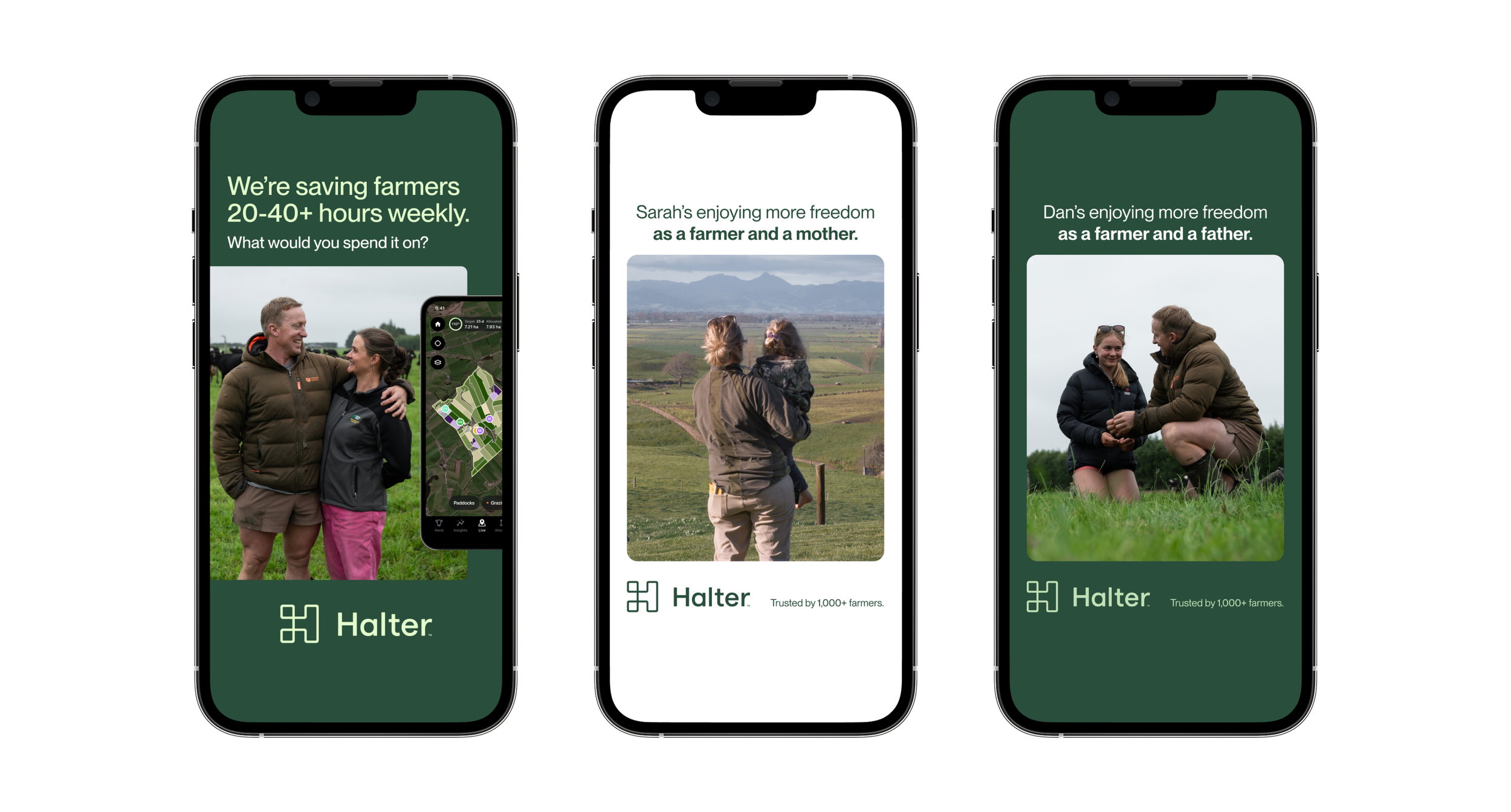
Turned Halter’s customer stories into its top-performing format: farmer and rancher case studies across New Zealand and the U.S., each cut into multiple ads, and a go-to tool for the sales team.
Creative enablement: built the content engine
Defined the creative strategy and visual identity across every ad set we ran for Halter.
Led a four-person creative team while making the work myself: scripting, directing and photographing shoots, and designing static and video ads in Figma and Adobe.
Codified what worked into reusable ad frameworks, giving Halter's go-to-market teams a repeatable creative playbook.
Used AI tools across concepting, copy variations and editing to test more creative every month without dropping quality.
Shipped at startup speed: a seasonal product update went from script to delivered in four days, from Thursday to Sunday.
Growth: owned the numbers
Owned creative performance against Halter's monthly lead targets in New Zealand and the U.S.
Ran a monthly test-and-learn cycle across audiences, angles and formats that scaled leads month on month, hitting 275% of the U.S. monthly MQL target, cutting cost per SQL by 61%, and giving sales a steady flow of qualified pipeline.
Helped pitch and win the account, then grew the relationship.
Insights
Conversations with Halter’s sales team and farmers, plus our own message tests, surfaced five insights that shaped the work:
Farmers buy outcomes, not features. Less labor and the ability to squeeze more feed out of their farm mattered more than shiny tech.
Halter was a one-feature brand. Most farmers knew it only as virtual fencing, so the greater value of what Halter could do and why it mattered was being lost.
Peers beat brands. Farmers, like most other buyers, want to hear from people just like them, and they have tight local communities.
The U.S. was a different sell. On vast ranches in a new market, the story needed to highlight different value propositions and build 0 to 1.
Make the value undeniable. Farmers wanted to see how it paid for itself. It was unclear what real-world outcomes virtual fencing enabled.
Key Decisions
-
Farmers doubted profit claims and were wary of a hard sell. So we told it as a chain they already understood: move cows in seconds, graze every paddock properly, grow more grass, put more milk in the vat. No financial jargon.
-
We made testimonial ads with farmers across the country, repurposing each one into smaller cutdowns and static assets. Prospects saw someone down the road, operating in the same conditions, running a more efficient farm. We took the same approach into US ranch stories.
-
To help balance budgets, we proved that authentic, phone-filmed ads showing basic demos and screen recordings performed exceptionally well. Producing these ads inexpensively allowed us to diversify ads and scale fast.

-
We split the funnel by the two things farmers wanted. Top-of-funnel ads sold the time given back and the ability to finally farm the way teams had always dreamed of. Lower down, ads proved the return with real farm results.
-
Our video ads showed a job that normally takes hours done in seconds on the app, often by an older farmer. There was no faking it. Farmers saw real-world usage that immediately made them realize how their day-to-day work could be transformed. It also showed just how straightforward the tech was to operate, answering the "too complicated" objection before anyone raised it.
-
Every month we tested audiences, message angles and formats (video, static, UGC). AI tools sped up every round of variations. What won became a formula: story flow, must-have elements, and the claims that landed. New ads took less guesswork, so lead volume grew month on month.